

Greenwich Graduate School
The postgraduate and research-focused academic platform of Greenwich University. Supporting Master's, MPhil, MS and PhD scholars through structured supervision, research development, academic mentoring and professional growth.
The Graduate School · Depth · above the eight schools
Where ambition earns its title
Programmes offered
Master's, MPhil and doctoral pathways. Coursework and research, built for professionals and scholars.
Master of Business Administration (1.5 Years)
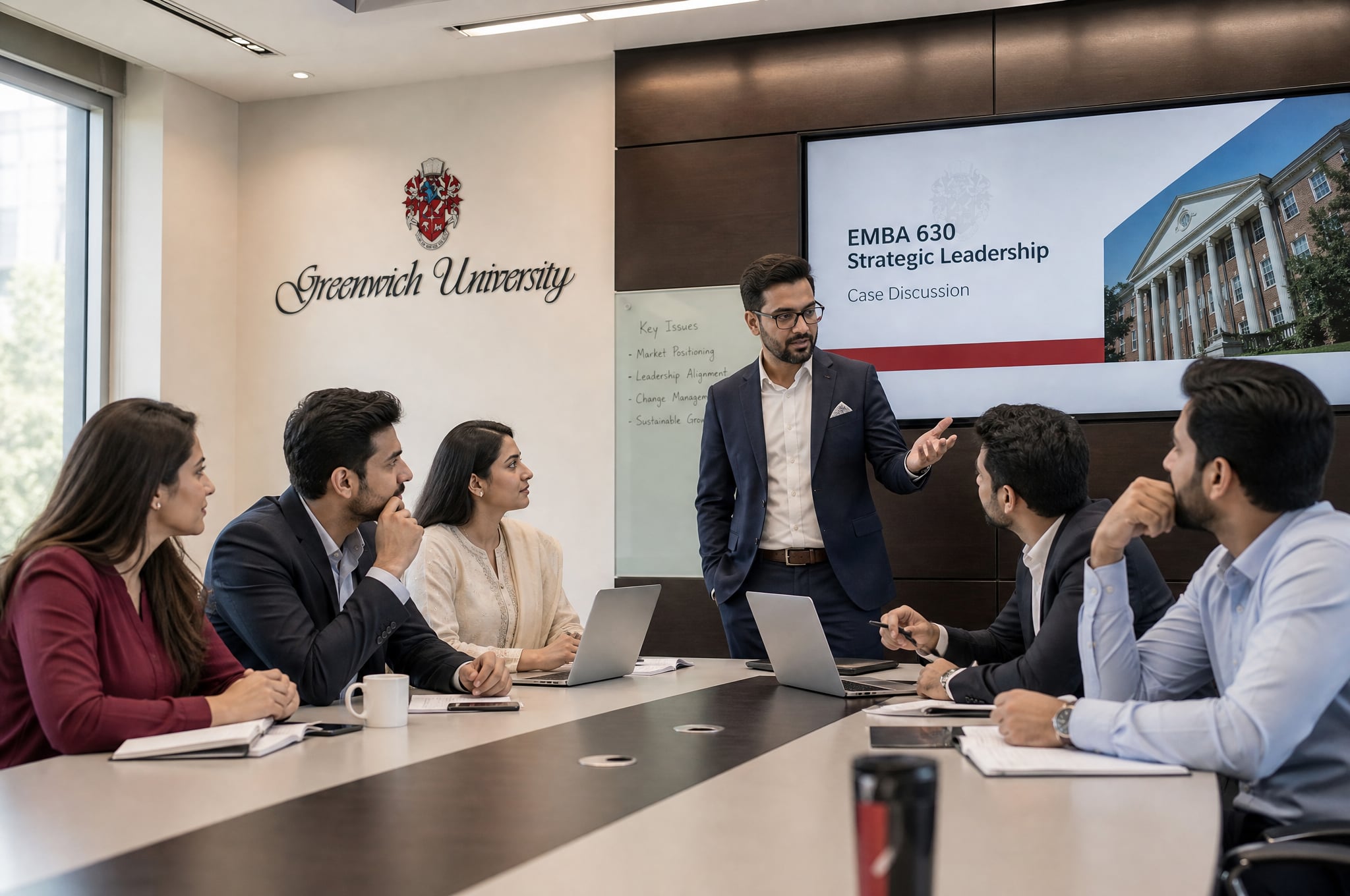
Executive Master of Business Administration (EMBA)
Master of Studies (MS) in Media & Communication Studies
Master of Science (MS) in Sustainable Fashion Innovation and Branding
MPhil in Economics
MPhil in Education
MPhil in English (Literature and Linguistics)
MPhil in International Relations
MPhil in Political Science
PhD in Business Administration
PhD in Economics
PhD in Mass Communication & Media Studies
PhD in Education
PhD in International Relations
Five reasons it sits above the eight.
- 01
One postgraduate desk
One admission process, whatever the discipline — master’s, MPhil or doctorate.
- 02
A supervisor from term one
Named, scheduled and on the record — not assigned in your final semester.
- 03
Weekends, by design
MPhil and PhD classes run Saturday and Sunday, around a working week.
- 04
Live problems, not cases
Ventures, venues, systems and communities from eight working schools downstairs.
- 05
A defence, in public
Work argued out loud in front of people qualified to dismantle it.
One school, one process and one standard.
Most postgraduate study in this country is an extension of undergraduate study — more lectures, longer essays, a thesis nobody reads. That fails the two people who most need it: the working professional who needs advancement they can prove, and the researcher who needs to contribute something original.
Postgraduate study at Greenwich is no longer scattered across faculties. It is one school, one process and one standard, with supervision drawn from all eight schools on this campus. If the enquiry is postgraduate, it starts here.
The Greenwich Research Commons
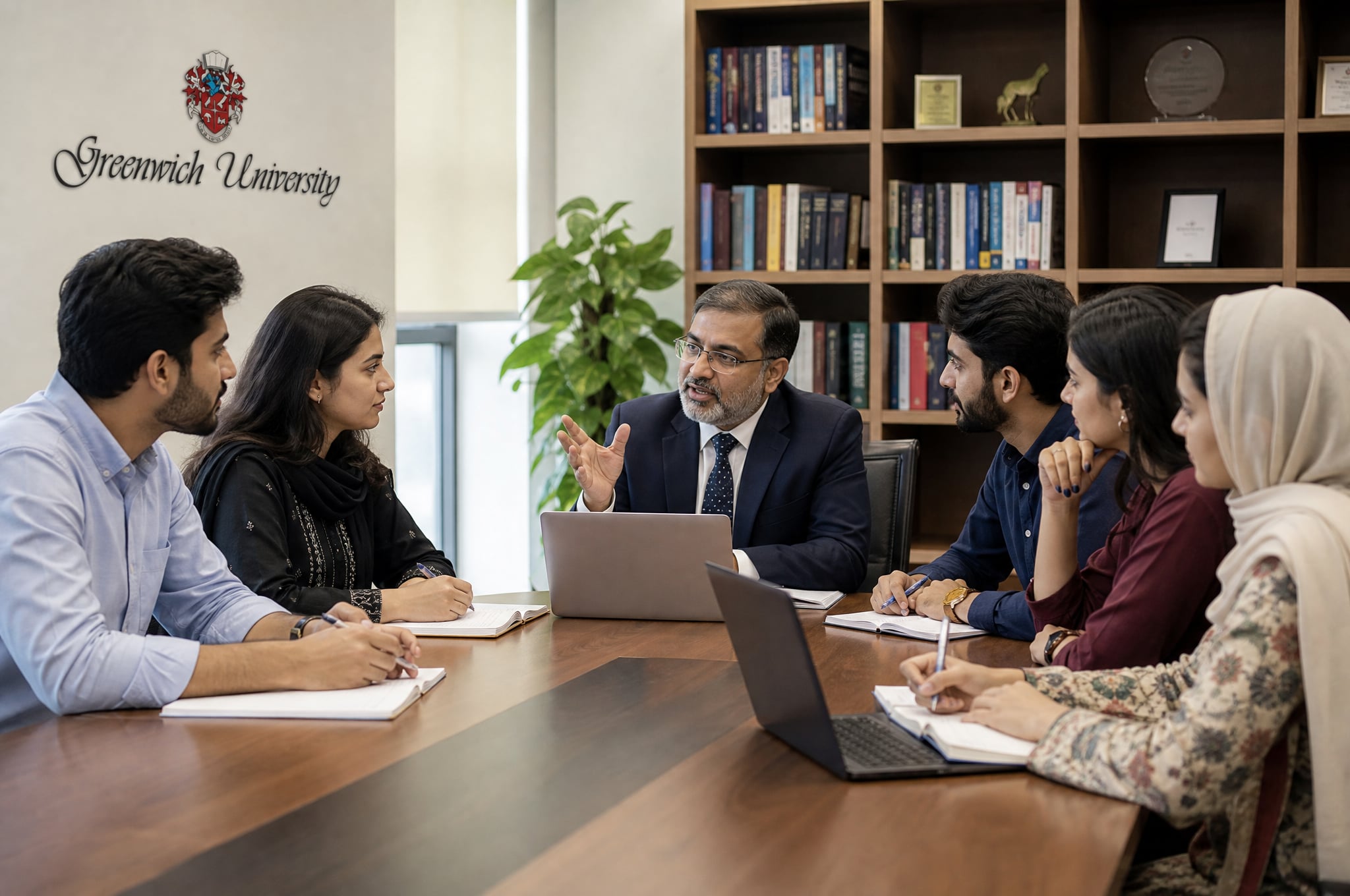
Not a floor of offices with a thesis deadline attached. Six spaces built for the two things postgraduate study actually requires: uninterrupted depth, and someone senior who will argue with you.
The research commons
Carrels, long tables and quiet.
The room that assumes you are here to produce something, not to attend something.
Graduate seminar rooms
Argument, not lecture.
Small-group teaching for mature students, with the reading done before anyone sits down.
Supervision & mentorship
A named supervisor from the first term.
Plus an industry mentor on professional routes. Regular, scheduled, on the record.
Thesis & viva suites
Defended out loud.
Where the work is defended to people qualified to dismantle it — and where PhD Progress Clinics keep candidates moving instead of drifting.
Journal & database access
Full research databases.
Plus the literacy to use them — search strategy, citation discipline, and knowing when a source is not good enough.
Writing & research clinics
Academic writing, methods and statistics on demand.
The clinic that turns a good idea trapped in bad prose into a publishable one.
Six steps, advisory to defence
The process every postgraduate route runs, whatever the discipline.
- 01Advise
- 02Fit
- 03Method
- 04Supervise
- 05Produce
- 06Defend
How a postgraduate route runs.
Advisory & fit
A real advisory meeting before you apply — programme fit, workload against your job, and an honest answer about whether now is the right time.
Methods & core
Research methods and core modules, with a named supervisor or mentor assigned from the first term rather than the last.
The applied contribution
A graded internship, industry capstone or research project drawn from a live problem in one of the eight schools.
Thesis, viva & publication
Written, defended in public, and where it merits it, published or turned into a policy brief that circulates.
Original contribution is the standard, not the aspiration.
A master’s elsewhere ends with a transcript and a thesis in a drawer. Here it ends with research produced, supervision logged, a defence passed — and where it merits it, a paper published or a policy brief in circulation.
About the Graduate School
Greenwich Graduate School is the dedicated postgraduate and research platform of Greenwich University, created to support advanced learning, doctoral inquiry and professional academic development. Through structured supervision, research training, academic mentoring and institutional support, it enables scholars to produce meaningful research that contributes to academia, industry, policy and society. From admission through proposal, coursework, thesis supervision, publication, defence and graduation.
Research areas
Six research clusters connect scholars with faculty expertise, supervisors, labs and publication opportunities.
Business, Management & Entrepreneurship
- Expertise: Strategy, marketing, organisational behaviour, SMEs
- Topics: Brand strategy, leadership, startup ecosystems
- Centre: Business Simulation & Incubation Lab
Economics, Finance & Development
- Expertise: Macroeconomics, corporate finance, development
- Topics: Financial inclusion, monetary policy, fintech
- Centre: Karachi Research Chair linkage
Computer Science, AI & Digital Transformation
- Expertise: Machine learning, data science, cybersecurity
- Topics: Applied AI, NLP, responsible AI, analytics
- Centre: AI Lab & IT Lab
Media, Communication & Creative Industries
- Expertise: Mass communication, film, digital media
- Topics: Audience studies, content strategy, media & AI
- Centre: ARY-linked media labs
Education, Policy & Leadership
- Expertise: Teacher education, curriculum, EdTech
- Topics: Learning outcomes, policy, educational leadership
- Centre: Education Research Centre
Social Sciences, Psychology & Community
- Expertise: Counselling, wellbeing, community development
- Topics: Youth mental health, resilience, social impact
- Centre: Thrive research & outreach
Graduate Research Development Centre. GRDC
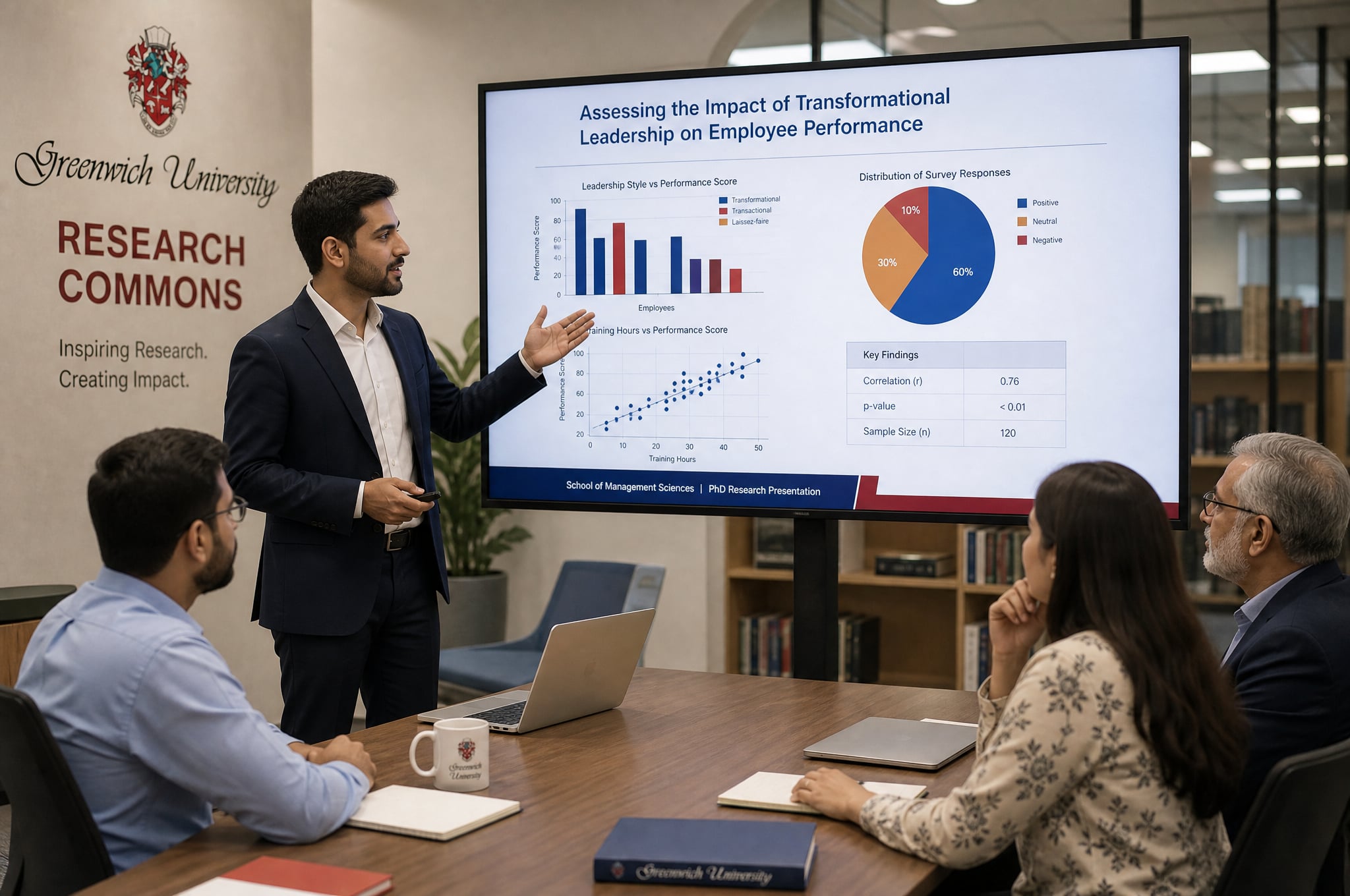
The GRDC strengthens postgraduate research skills. Academic writing, methodology, data analysis, publication readiness and thesis development.
The graduate journey
A clear, supervised pathway from admission to graduation.
Admission
Application, test/interview and merit review.
Coursework
Core and specialisation modules with research methods.
Research Proposal
Topic selection, literature and proposal defence.
Supervisor Allocation
Matched to an approved supervisor by research area.
BASR Approval
Board of Advanced Studies & Research reviews and approves.
Research Work
Fieldwork, experiments, analysis and writing.
Progress Reviews
Periodic milestones and supervisor sign-off.
Publication Support
Paper development and submission to journals.
Thesis Submission
Formatting, similarity check and submission.
Viva / Defence
Local and foreign evaluation and oral defence.
Graduation
Final degree recommendation and conferral.
Research support services
Policies & academic requirements
Key policies and forms governing postgraduate study. Document links are placeholders for the handoff.
BASR & Doctoral Committee
The Board of Advanced Studies & Research (BASR) safeguards postgraduate research quality. Overseeing approvals, supervision, progress and final thesis processes.
Graduate student life
Admissions
Direct entry to postgraduate and doctoral study at Greenwich.
Eligibility
Required documents
Admission may include a test and/or interview. Deadlines follow the Greenwich intake calendar. Merit- and need based assistantships are available for research students.
Begin your research journey.
Join a serious postgraduate community built for scholars, professionals and future academic leaders.
The eight schools produce practitioners. This one produces the people who will lead, teach and question them.
It draws supervisors, data and live problems from every school on this campus — skm.’s ventures, curate’s venues, Computing’s systems, thrive’s communities.
A graduate school with a working ecosystem downstairs does not need to invent case studies.
Research produced, supervision logged, a defence passed.
And where it merits it, a paper published or a policy brief in circulation.
Where the Graduate School takes you
GX in the Research Commons
Postgraduate study is mostly solitary, which is exactly why the pillars still apply — earned here through the Graduate Research Colloquium, Executive Roundtables and assistantships supervising the students coming up behind you.
The GX Passport is the documented record of participation, leadership, service and professional development, completed alongside the degree. Explore GX
Your school is your professional home. Greenwich is your wider world.
What a Graduate School student builds with each of the other units.
skm. School of Business
study the ventureFamily-enterprise and entrepreneurship research on live firms.
Greenwich School of Computing
study the systemAI, data and security research with real infrastructure behind it.
thrive School of Psychology
study the personYouth resilience and wellbeing research with ethics approval.
sm. Education & Social Sciences
study the societyThe Karachi Social Survey and education policy research.
curate School of Hospitality
study the operationTrading venues as standing field sites for applied research.
ARY School of Media Studies
publish the findingsResearch communicated to a public audience, not only a journal.
kak. School of Law
study the ruleLegal and policy research, and reform argued in public forums.
Executive Development Centre
meet the industryExecutive roundtables and the capstone problems industry brings.
Testing differs by level
Master’s takes the University Placement Test (40 marks). MPhil and MS take GAT General (40 marks). PhD takes GAT Subject (40 marks) with a 3.0 CGPA threshold, and document scrutiny takes seven days — build it into any timeline you promise.
Before you apply
A research proposal of about 1,000 words accompanies an MS or MPhil application — field, problem, rationale, experience, methodology. MPhil and PhD classes run Saturday and Sunday, which makes them the realistic route for a working professional.
What a doctorate asks of you
Beyond coursework: a public defence, evaluation by at least two PhD experts from academically advanced foreign countries, a plagiarism test, and at least one paper published in an HEC-approved journal. We set that expectation on day one, not in year three.
Don't just hold a degree. Contribute something
HEC recognised